

Every electronic device you use, from a phone charger to a factory controller, has a printed circuit board (PCB) inside it. If you have a circuit design and want to turn it into a working board, you need a PCB manufacturing service. This guide explains what that service does, how the process works, and what to prepare before you order, whether you are a first-time student or a growing business.
What Is PCB Manufacturing?
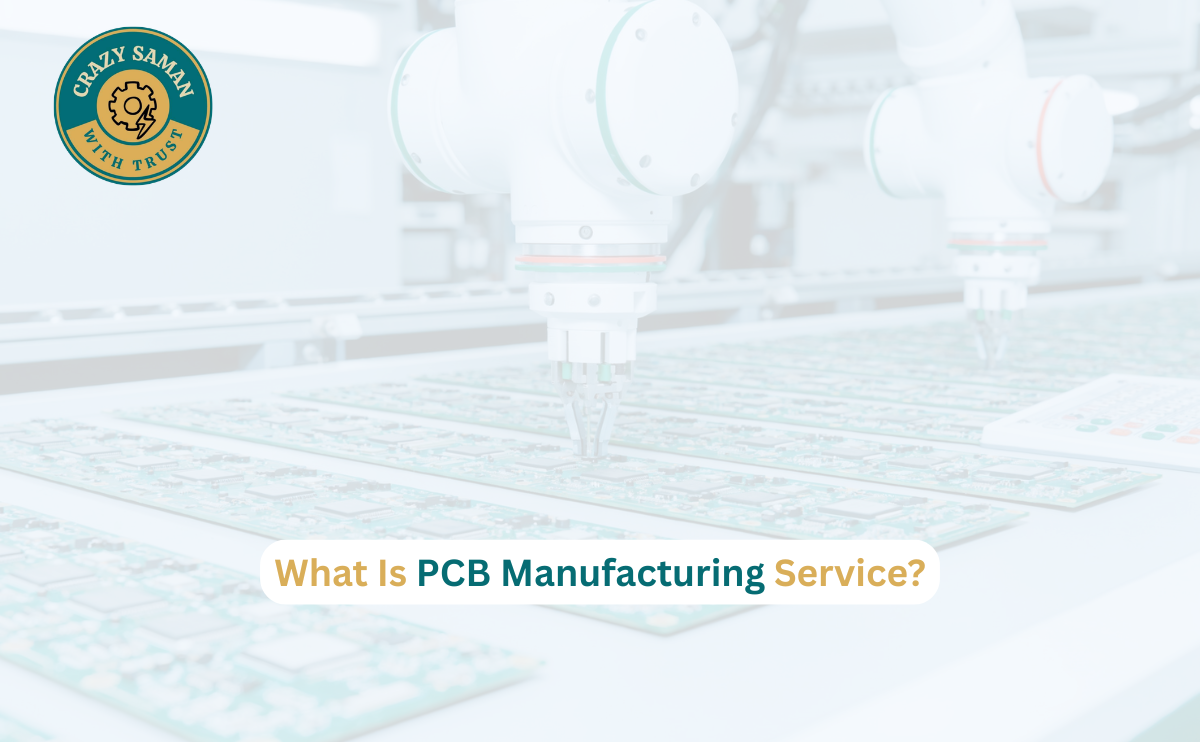
PCB manufacturing is the process of turning your digital circuit design into a physical board. A PCB is a flat board, usually made of fiberglass (FR-4), with thin copper tracks that connect components such as resistors, capacitors, microcontrollers and sensors.
A PCB manufacturing service takes your design files and produces the bare board: copper layers, drilled holes, solder mask, silkscreen and surface finish. You then solder your parts onto it, or have them assembled for you. Many beginners confuse this with assembly, but manufacturing only covers the board itself.
Why Do You Need a PCB Manufacturing Service?
You can make a simple board at home with etching chemicals, but the results rarely hold up. Hand-made boards struggle with fine tracks, plated holes and multiple layers. A professional service gives you:
- Consistent quality: Industrial machines control track width, hole size and layer alignment far more precisely than manual methods.
- Professional finish: Solder mask and silkscreen make boards easier to solder, inspect and debug.
- Complex designs: Double-sided and multilayer boards are not realistic to make at home.
- Time savings: You focus on design and testing while the factory handles fabrication.
- Reliability: Electrically tested boards reduce the risk of hidden faults that waste days of troubleshooting.
2. How Does PCB Manufacturing Work?
The PCB manufacturing process looks complicated, but for you as a customer it comes down to a few clear steps.
Prepare Your PCB Design
Start by finishing your schematic and board layout in PCB design software. Popular options include KiCad (free), EasyEDA, Altium Designer, Autodesk Eagle and OrCAD. Before exporting, run your software’s design rule check (DRC) so you catch spacing or clearance errors early.
Generate Gerber Files
The Gerber file for PCB production is the standard language factories read. Each Gerber file describes one layer, such as top copper, bottom copper, solder mask or silkscreen. Along with Gerbers, you export a drill file (usually Excellon format) that tells the machine where to drill. Most design tools have a one-click export option, and it is a good habit to open the files in a Gerber viewer to confirm everything looks right.
Upload Your Design
Compress all your Gerber and drill files into a single ZIP and upload it through the manufacturer’s website. Reviewing the files before production begins is where a good manufacturer earns its keep. Engineers check for problems like tracks that are too close, missing drill layers or unusual board outlines, and flag them before you pay for a faulty batch.
Select PCB Specifications
Next you choose how your board should be built. The main options are:
- Layers: Single-sided, double-sided, or multilayer PCB manufacturing (4, 6, 8 layers and above) for compact, high-speed or dense designs.
- Board thickness: Standard PCB thickness options start around 0.8 mm and go up to 2.0 mm or more. 1.6 mm is the most common choice for general projects.
- Copper weight: 1 oz is typical. Heavier copper suits high-current boards such as power supplies and motor drivers.
- Solder mask colour: Green is the classic, but blue, black, red and white are common too.
- Surface finish: This protects exposed copper and affects soldering quality. HASL (hot air solder levelling) is affordable and works well for most through-hole and general-purpose boards. ENIG (electroless nickel immersion gold) gives a flat, corrosion-resistant surface, which suits fine-pitch parts, BGAs and boards that need a longer shelf life.
Get Your Quote
Once your specs are set, you receive a price based on board size, layers, quantity and finish. Take a moment to compare not just the price but also the lead time and what testing is included. After you confirm the order, production begins.
Who Can Use PCB Manufacturing Services?
Anyone with a circuit design can. Here is how different users benefit.
Students & Engineering Projects
Looking for PCB for students and final-year projects? A custom board makes a project look and work like a real product, and it is far more dependable than a tangle of jumper wires on a breadboard. Small quantities are usually enough, so it fits a student budget.
Startups
PCB for startups matters at every stage, from proof of concept to pilot runs. Getting a reliable prototype quickly lets you test your idea, show investors a working unit and refine the design before committing to larger volumes.
Hobbyists & Makers
If you build gadgets, audio equipment, LED projects or home automation, a custom PCB replaces messy wiring with something neat and repeatable. It also makes your project easy to share or rebuild.
Robotics & IoT Developers
Robots and IoT devices need compact boards with sensors, wireless modules and power management, often in tight enclosures. Multilayer boards and precise manufacturing help here, especially when signal quality and space are limited.
Industrial Electronics Companies
Manufacturers of controllers, power electronics, instrumentation and automation equipment need repeatable quality across large runs. Consistent specifications and dependable delivery matter as much as unit price.
PCB Prototype vs Bulk Manufacturing
These two services solve different problems.
A PCB prototype service is designed for small quantities, often between 5 and 10 boards. You use it to test your design, find mistakes and improve the layout. Speed and flexibility matter more than the lowest per-unit price, and it is normal to go through more than one prototype round.
Bulk PCB manufacturing comes after your design is proven. You order larger quantities, and the cost per board drops because setup costs are spread across the run. Consistency across every board becomes the priority.
A sensible path is to prototype first, fix issues, run a small pilot batch, and only then go to bulk. Skipping the prototype stage to save a little money often ends up costing more.
What Information Do You Need to Order a PCB?
Keep this checklist ready so your order goes smoothly:
- Gerber files and drill files in one ZIP
- Number of layers
- Board dimensions and shape
- Board thickness
- Copper weight
- Solder mask and silkscreen colour
- Surface finish (HASL, ENIG or another option)
- Quantity needed
- Any special requirements, such as impedance control, V-cut panelisation or specific tolerances
If you are unsure about any option, it is better to ask before ordering. A quick conversation with the manufacturer can save you a costly redo.
Why Choose CRAZY SAMAN for PCB Manufacturing?
Choosing a manufacturer is really about trust. You want clear communication, dependable quality and support when something is unclear. CRAZY SAMAN is built around the needs of Indian makers, students, startups and businesses, so you can handle custom PCB manufacturing without the hassle of importing boards from overseas.
Here is what you can expect:
- Custom PCB manufacturing suited to your exact design and specifications
- Simple online PCB order in India with an easy file upload and quote process
- Options for prototypes as well as larger production runs
- Support for a range of specifications, including different thicknesses, surface finishes and multilayer boards
- Electronic components online in India available alongside your PCB needs, so you can source parts and boards in one place
- Guidance for beginners who are ordering their first board
Having your boards and components come from a single source saves time and cuts down on coordination between suppliers.
Turn Your PCB Design Into Reality
Your design deserves to be more than a file on a screen. Whether you are building a final-year project, launching a product or scaling up production, the right manufacturing partner makes the difference.
Upload your Gerber files to CRAZY SAMAN today, choose your specifications and get a quote for your custom PCB. Have a question first? Get in touch and we will help you pick the right options.
📦 Order Your Components Today
Crazy Saman — Delhi’s Best Electronic Components Store
🌐 Website: crazysaman.com 📞 Call / WhatsApp: 9289245581 📍 Location: Delhi, India — Pan-India Delivery Available ⏰ Business Hours: Monday to Saturday | 10:00 AM – 7:00 PM
Frequently Asked Questions
What is a PCB manufacturing service?
It is a service that takes your PCB design files and produces the physical circuit board, including copper layers, drilling, solder mask, silkscreen and surface finish.
What files do I need to order a PCB?
You need Gerber files for each layer and a drill file, usually supplied together as a ZIP. Your design software can export these.
Which PCB design software should a beginner use?
KiCad and EasyEDA are popular starting points because they are free or easy to access and have large learning communities.
What is the difference between HASL and ENIG?
HASL is a cost-effective solder coating that suits most general projects. ENIG has a flat gold finish that works better for fine-pitch components and offers longer shelf life, at a higher cost.
What is the standard PCB thickness?
1.6 mm is the most common thickness. Thinner and thicker options are available depending on your application.
How many boards should I order for a prototype?
Most people order between 5 and 10 boards. That gives you spares in case of soldering errors or testing damage.
Can I order PCBs online in India?
Yes. You can upload your design files, choose specifications and receive a quote online, then have the boards delivered to your address.
When should I switch from prototype to bulk manufacturing?
Once your design has been tested, corrected and confirmed to work, you can move to bulk production for a lower cost per board.