


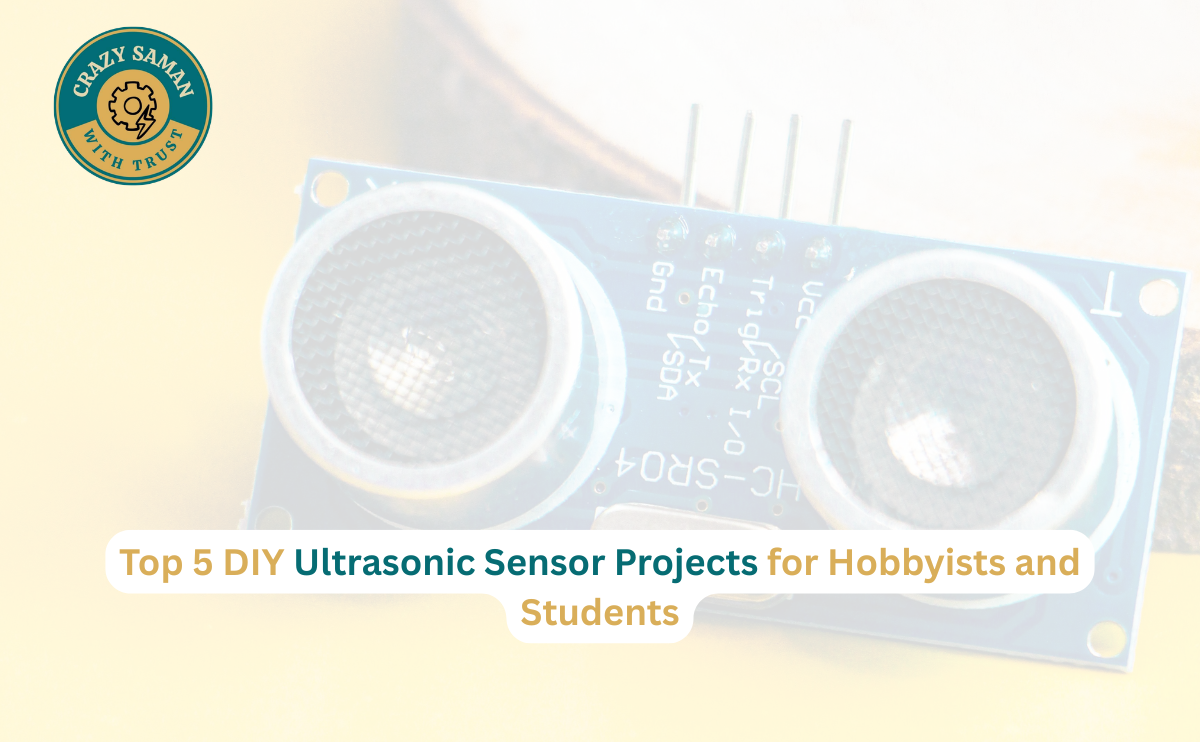
If you’re just getting started with electronics or simply looking for a fun weekend project, ultrasonic sensor projects are one of the best places to begin. This small, inexpensive component can do a surprising amount — measure distance, detect obstacles, monitor liquid levels, and much more. It’s affordable, widely available, and beginner-friendly, which makes it a favorite among students and hobbyists alike.
In this blog, we’ll walk through five practical DIY ultrasonic sensor projects that anyone can build, regardless of experience level. Whether you’re working on a school project or simply want to get more comfortable with your Arduino kit, these ideas are a great place to start — and if you need quality components to build them, crazysaman has you covered.
Robot that Avoids Obstacles
This is probably the most popular pick among ultrasonic sensor projects, and for good reason — it looks impressive and isn’t too difficult to build. The concept is simple: build a small robot car, attach an ultrasonic sensor to the front, and program it to change direction whenever the sensor detects an object nearby.
You’ll need an Arduino board, two motors, a motor driver, an ultrasonic sensor (such as the HC-SR04), and a basic chassis. The sensor continuously measures distance, and when an object comes within a certain range (typically 10–15 cm), the Arduino signals the motors to stop or turn. This project is an excellent way for beginners to get hands-on experience with both coding and hardware.
Smart Parking Help System
This is a genuinely useful project you can set up at home or even on a college campus. The idea is to place an ultrasonic sensor at the entrance of a parking space to detect whether it’s occupied. If a car is already parked there, the sensor sends a signal, and an LED (red or green) indicates whether the spot is available.
For a more advanced version, you can add an LCD display that shows “Available” or “Occupied” in real time. This project solves a real-world problem and makes a strong impression for college submissions, since it directly reflects smart-city technology concepts.
System for Finding the Water Level
If you’ve ever dealt with an overflowing or unexpectedly empty water tank, this project solves that exact problem. The ultrasonic sensor is mounted at the top of the tank and measures the distance to the water’s surface. From that distance, you can calculate how full the tank is.
The Arduino processes this data and can trigger a simple display or buzzer alert when the water level gets too low or too high. With the addition of a WiFi module, you can even send notifications directly to your phone. This is one of the most practical projects on the list, with real day-to-day utility.
Display for the Ultrasonic Range Finder
This project is ideal for anyone interested in building measurement tools. Essentially, you’re creating a digital distance meter — an electronic alternative to a tape measure. The ultrasonic sensor measures distance, and the reading is instantly displayed on an LCD or 7-segment display.
While simple, this project teaches valuable concepts like sensor calibration and display interfacing. You can take it further by adding a unit-switch feature (cm/inches) or a “hold” button to lock the current reading on screen.
An Ultrasonic Flow Sensor for Measuring Liquids
This is a slightly more advanced project, but a rewarding one. Ultrasonic flow sensors measure the flow rate of a liquid without making physical contact with it, making them highly accurate and reliable. These sensors are widely used in industrial applications, so this project gives you a taste of real-world engineering.
In the DIY version, you can set up a simple pipe system to measure liquid flow and collect data through your Arduino. This project requires a bit more precision and research, but it’s a great next step if you’re ready to push your skills further.
How Ultrasonic Sensors Work
Let’s break down how this sensor actually works. An ultrasonic sensor emits sound waves at frequencies beyond human hearing — hence the name “ultrasonic.” It sends out a sound wave, which bounces off a nearby object and returns to the sensor. By measuring the time it takes for the wave to travel out and back, the sensor can calculate distance.
The formula is straightforward:
Distance = (Time × Speed of Sound) / 2
The division by 2 accounts for the round trip — the wave has to travel to the object and back. This simple principle is the foundation behind every project mentioned above.
Working with Arduino
Arduino is the ideal platform for ultrasonic sensor projects, especially for beginners. The Arduino IDE is easy to use, the community support is excellent, and wiring up a sensor only takes a few connections and a breadboard.
A popular sensor like the HC-SR04 uses just four pins: VCC, GND, Trigger, and Echo. The code logic is equally simple — the Arduino briefly sets the trigger pin HIGH, then waits for a return signal on the echo pin. There are plenty of free tutorials and code examples online to help you get up and running quickly, and you can pick up a reliable HC-SR04 sensor and Arduino board from crazysaman to get started right away.
Why Students Should Do Ultrasonic Projects
These projects aren’t just fun — they’re genuinely valuable for learning. They combine sensors, circuits, coding, and real-world problem-solving into a single hands-on experience. These are exactly the skills that carry over into electronics, robotics, and engineering careers, and that’s exactly why ultrasonic sensor projects are so widely recommended for students.
They’re also budget-friendly. You don’t need expensive lab equipment — a basic Arduino kit and an ultrasonic sensor are enough to build something impressive. These projects make excellent choices for school and college submissions, since they’re visually engaging and easy to explain to evaluators.
Conclusion
Ultrasonic sensors are small components with a surprisingly wide range of applications. From obstacle-avoiding robots to water level monitoring systems, these five ultrasonic sensor projects offer something for every skill level. If you’re new to electronics, start with a simpler build and gradually work your way up to more advanced projects.
And if you’re looking for quality sensors, Arduino kits, or electronic components for your next build, check out crazysaman — you’ll find reliable, affordable components to help bring your ultrasonic sensor projects to life. Visit crazysaman today and start building.
📦 Order Your Components Today
Crazy Saman — Delhi’s Best Electronic Components Store
🌐 Website: crazysaman.com 📞 Call / WhatsApp: 9289245581 📍 Location: Delhi, India — Pan-India Delivery Available ⏰ Business Hours: Monday to Saturday | 10:00 AM – 7:00 PM