

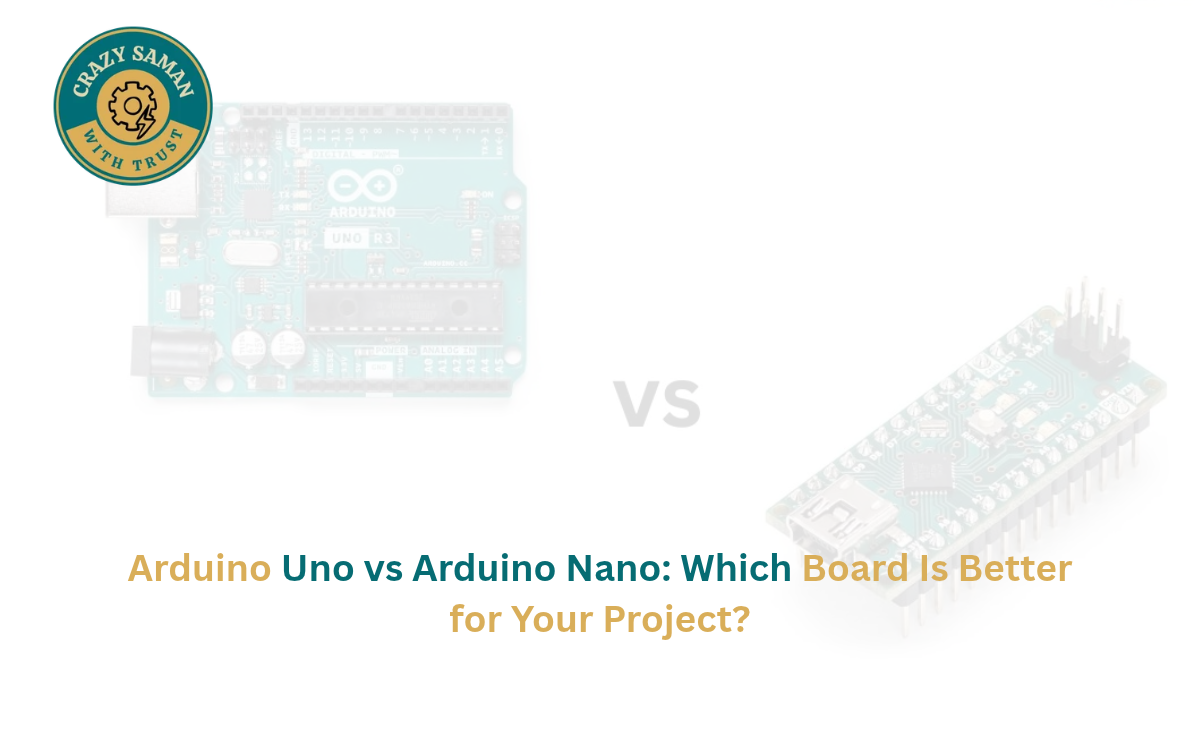
Standing in front of two Arduino boards and wondering which one to pick? The Arduino Uno vs Arduino Nano question is the first one most students and beginners ask. Both boards use the same ATmega328 chip and the same Arduino IDE. This guide explains Arduino Uno vs Arduino Nano in simple words so you can choose the right board.
Arduino Uno vs Arduino Nano: Understanding the Main Differences
The biggest difference in Arduino Uno vs Arduino Nano is shape. The Uno is a full-size board with a USB-B port, a DC power jack and female headers. The Nano is thumb-sized, with a Mini-USB port and pins that plug straight into a breadboard.
Inside, both have 32 KB flash memory, 2 KB SRAM and a 16 MHz clock. So Arduino Uno vs Arduino Nano is less about power and more about size, connectors and how you plan to build.
Arduino Uno and Nano Difference in Size, Pins and Connectivity
Size is the clearest Arduino Uno and Nano difference. The Uno is about 68.6 x 53.4 mm, while the Nano is only about 45 x 18 mm. Both give 14 digital pins (6 of them PWM), but the Nano has 8 analog inputs against 6 on the Uno.
The Uno takes a USB-B cable and a 7–12V DC jack. The Nano uses a Mini-USB cable and takes external power through the VIN pin. Many Nano boards use a CH340 USB chip, so you may need to install a driver once. In Arduino Uno vs Arduino Nano, this small detail often surprises beginners.
Arduino Uno Features Every Beginner Should Know
The Arduino Uno features that matter most:
- Female headers for easy jumper-wire and shield connections
- DC power jack plus USB power
- Reset button and an onboard LED on pin 13
- A removable chip on DIP versions
- Support from nearly every tutorial online
These Arduino Uno features make it forgiving for learners, since you can plug wires in and out without soldering.
Arduino Nano Features and Benefits for Compact Projects
The Nano packs the same brain into a tiny board:
- Breadboard-friendly pins, so no extra wires are needed
- Small size that fits inside robots and project boxes
- Two extra analog inputs
- Lower cost in most shops
If your build must stay small, the Nano wins Arduino Uno vs Arduino Nano straight away.
Arduino Board for Beginners: Uno or Nano?
For a first Arduino board for beginners, the Uno is the safer pick. Its large size and female headers make wiring simple. If you already know basic wiring or your budget is tight, the Nano works equally well as an Arduino board for beginners. In Arduino Uno vs Arduino Nano for first-time users, comfort matters more than specs.
Arduino Nano for School Projects and Robotics Models
The Arduino Nano for school projects is popular because it is small, cheap and fits on a breadboard. It suits a line-following robot, an obstacle-avoiding car, a smart dustbin or a mini home automation model. Since robot chassis have little space, the Arduino Nano for school projects keeps wiring neat and light, and students can leave it inside the finished model. For exhibitions with limited space, Arduino Uno vs Arduino Nano usually ends in the Nano’s favour.
Arduino Uno vs Arduino Nano: Price, Size and Project Compatibility
On price, the Nano is usually cheaper, but rates depend on the version and seller, so compare before buying. On size, the Nano wins. On compatibility, the Uno works with stacking shields, while the Nano suits breadboards and custom boards. In Arduino Uno vs Arduino Nano, neither is best for everything: the Uno suits learning and shield-based builds, and the Nano suits compact final models.
Which Arduino Board Should I Buy for My Project?
Many students ask, “Which Arduino board should I buy?” Use this quick guide:
- First time learning Arduino: Uno
- Using a motor or LCD shield: Uno
- Compact robot or small model: Nano
- Permanent project inside a box: Nano
- Tight budget: Nano
When deciding which Arduino board should I buy, think about where the project will finally live, not just where you start. Arduino Uno vs Arduino Nano is easier to settle once you picture the finished model.
Can Arduino Uno and Arduino Nano Run the Same Projects?
In most cases, yes. Both boards use the ATmega328 and the same IDE, so code written for one usually runs on the other after you select the right board and adjust pin numbers. Some Nano clones need the “old bootloader” option when uploading. LEDs, sensors, relay modules, servo motors and LCDs work on both. The limits are shared too, since 2 KB SRAM restricts very large programs on either board. That is why Arduino Uno vs Arduino Nano rarely ruins a project, whichever you pick.
Where to Buy Arduino Uno and Arduino Nano in India?
If you are comparing Arduino Uno vs Arduino Nano and want a trusted place to buy, CRAZY SAMAN can help. We offer Arduino boards, sensors, jumper wires, breadboards, DC motors and electronic modules for school projects, science exhibitions, robotics and DIY experiments.
Customers near Sultanpuri, Delhi can ask about local delivery through Porter, subject to availability and delivery charges. You can also call in advance to confirm stock and collect the board from our location. We try to keep prices competitive so students, parents, teachers and hobbyists can find a board within budget, and you are welcome to compare with Amazon, Flipkart, Meesho and other platforms before ordering. Browse our products online, check specifications and contact CRAZY SAMAN to discuss your project, bulk orders, pricing and delivery.
Frequently Asked Questions About Arduino Uno vs Arduino Nano
Which is better for beginners in Arduino Uno vs Arduino Nano?
The Uno is easier for first-time wiring, but the Nano is just as capable.
Is the Nano as powerful as the Uno?
Yes. Both have the same chip, memory and 16 MHz speed.
Do I need a driver for the Nano?
Boards with a CH340 chip may need a one-time driver install.
Can I power the Nano with a battery?
Yes, through the VIN pin with about 7–12V.
Is the Nano good for school exhibition models?
Yes, its small size makes it ideal for compact models and robots.
📦 Order Your Components Today
Crazy Saman — Delhi’s Best Electronic Components Store
🌐 Website: crazysaman.com 📞 Call / WhatsApp: 9289245581 📍 Location: Delhi, India — Pan-India Delivery Available ⏰ Business Hours: Monday to Saturday | 10:00 AM – 7:00 PM