


A line follower robot is one of the most popular school and science exhibition projects, and for good reason. It is simple to understand, fun to watch and teaches the basics of sensors, motors and code. The trouble starts when you try to buy the parts. Many students are not sure which line follower robot components they really need, and end up with a missing wire or the wrong motor on the day before submission. This guide lists every part, explains what it does and helps you buy only what your project needs.
Line Follower Robot Components Required for a School Project
A line follower robot drives along a dark line on a light surface without any human control. Sensors read the surface, the controller decides what to do, and the motors turn the wheels. So the main line follower robot components fall into four groups: sensing, thinking, moving and power.
Sensing means IR sensors. Thinking means an Arduino board. Moving means a motor driver, motors and wheels. Power means a battery and a switch. Add a chassis to hold everything together and a few jumper wires to connect it all. Once you see the project this way, the list of line follower robot components stops looking long.
Line Follower Robot Parts List with Their Uses
Here is a simple line follower robot parts list for a basic two-sensor robot:
- Arduino Uno or Nano: the brain that reads sensors and controls motors.
- IR sensor modules (2 or 3): detect the black line on the floor.
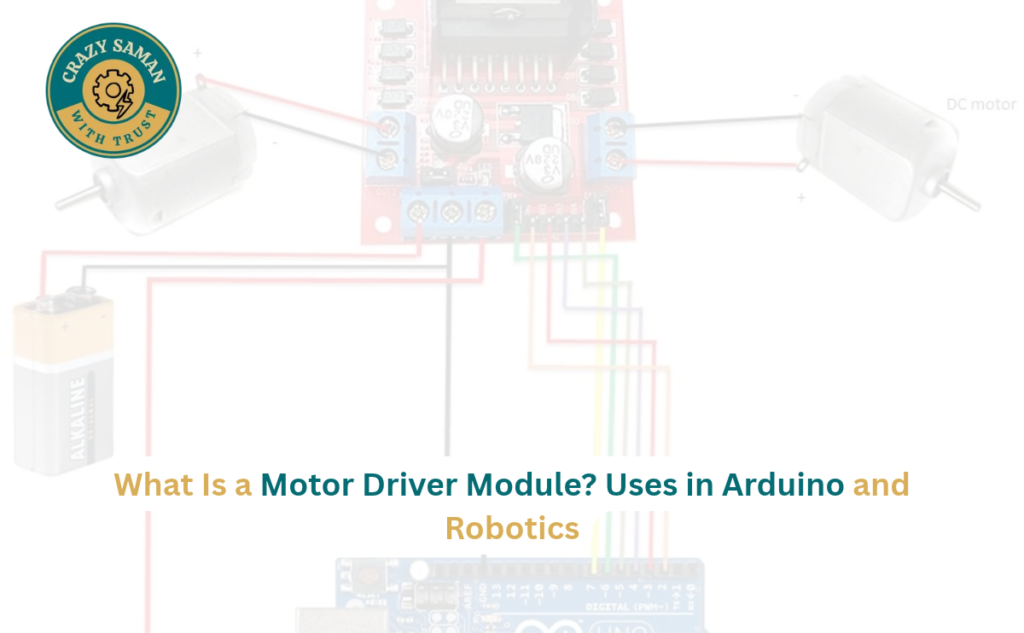
- L298N motor driver: lets the Arduino drive the motors safely.
- DC gear motors (2): turn the wheels at a usable speed.
- Wheels (2) and a caster wheel: two drive wheels and one free wheel for balance.
- Chassis: acrylic or plastic base to mount the parts.
- Battery with holder and switch: powers the whole robot.
- Jumper wires: connect everything without soldering.
If you keep this line follower robot parts list handy while shopping, you can tick items off one by one and avoid last-minute trips.
IR Sensor for Line Follower Robot and How It Works
An IR sensor for line follower robot projects has two small parts: an infrared LED that sends out light and a photodiode that receives it. On a white surface, most of the light bounces back. On a black line, most of it is absorbed. The sensor module compares the two and gives a simple HIGH or LOW signal to the Arduino.
Most modules have a small screw that adjusts sensitivity, and an LED that glows when the line is detected. Two sensors are enough for beginners, one on each side of the line. A third sensor in the middle makes turns smoother. Keep the sensors close to the ground, around 5 to 10 mm, for the best reading. Among all line follower robot components, the sensors need the most patience while setting up.
Arduino Line Follower Robot: Controller and Circuit Requirements
An Arduino line follower robot is the most common choice because the board is cheap, well documented and easy to program. The Uno is good if you want pins to spare, while the Nano is smaller and fits neatly on a compact chassis.
The code is not complicated. If the left sensor sees the line, turn left. If the right sensor sees it, turn right. If neither does, go straight. For the circuit you need digital input pins for the sensors, and output pins for the motor driver, including two PWM pins if you want speed control. Test the code with the wheels lifted off the table first. It saves many small crashes, and these line follower robot components are not meant to fall off desks.
Choosing a DC Gear Motor for Robot Projects
A plain DC motor spins very fast with little force, which makes a robot jittery. That is why a DC gear motor for robot projects is the better pick. The built-in gearbox slows the speed down and increases torque, so your robot moves steadily and can carry the battery weight.
For a school line follower, motors in the 100 to 200 RPM range work well. Faster motors look exciting but make it hard for the sensors to react in time, especially on sharp turns. Buy two motors of the same type, and choose wheels that fit the shaft properly. Good motors matter more than anything else on the list of line follower robot components, because a robot can only be as smooth as its wheels.
Robot Components for Students and Beginners
Many robot components for students come as ready sets, but buying parts one by one gives you more control over cost and quality. For a first project, keep things simple: two IR sensors, one motor driver, two motors and a common Arduino board. You can always upgrade to a sensor array later.
Also keep a small spare kit: a few extra jumper wires, a spare sensor and a spare battery holder. Beginners often damage a part while testing, and having a spare saves a whole day. Choosing line follower robot components that are easy to find again helps if you want to build a second, better version next year.
How to Connect Sensors, Motors and Arduino in a Line Follower Robot
Wiring is where most mistakes happen, so go slowly:
- Connect each IR sensor’s VCC and GND to the Arduino 5V and GND, and its OUT pin to a digital pin.
- Connect the motor driver input pins to four digital pins on the Arduino.
- Connect the two motors to the output terminals of the L298N.
- Connect the battery to the driver’s power terminal.
- Join the Arduino GND and the driver GND together. This common ground is essential.
If a wheel spins the wrong way, simply swap the two wires of that motor. Check each connection once before powering on, because loose jumper wires cause most strange behaviour in line follower robot components.
How to Choose the Right Battery for a Line Follower Robot
Motors need more power than sensors, so battery choice matters. Two 18650 cells in a holder give about 7.4V and work well with an L298N driver. Remember that this driver drops around 2V, so the motors get a little less than the battery voltage.
Avoid very small batteries, because they run out quickly and cause the Arduino to reset when the motors start. Rechargeable cells save money over a few weeks of testing. Always check polarity before connecting, and add a switch so you do not have to pull wires to turn the robot off. A stable supply keeps all line follower robot components working properly.
Common Problems When Building a Line Follower Robot
- Robot does not follow the line: adjust sensor sensitivity or lower the sensors closer to the ground.
- Robot zigzags: reduce motor speed or add a small delay in the code.
- Arduino keeps restarting: the battery is weak or the power wiring is loose.
- One wheel does not move: check the motor wires and the driver connections.
- Sensors give random readings: strong sunlight or shiny floors confuse IR light, so test on matte paper with a thick black tape track.
Most of these problems come from loose wiring or a rushed setup, not from faulty line follower robot components.
Where to Buy Line Follower Robot Components for School Projects?
Looking for electronic components for your school project? CRAZY SAMAN offers a range of electronic products, including Arduino boards, sensors, jumper wires, breadboards, DC motors and electronic modules for school projects, science exhibitions, robotics and DIY experiments. Customers near Sultanpuri, Delhi can ask about local delivery through Porter, subject to availability and delivery charges. You can also contact us in advance to confirm stock and collect your order from our location.
We try to keep prices competitive so that students, parents, teachers and hobbyists can find suitable products within their budget. Feel free to compare our rates with Amazon, Flipkart, Meesho and other platforms before buying. Browse the products at crazysaman.com, check the specifications and contact us to discuss your project, bulk orders, pricing and delivery. Getting all your line follower robot components from one place makes your project much easier to finish.
Frequently Asked Questions About Line Follower Robot Components
What are the basic line follower robot components?
You need an Arduino board, IR sensors, a motor driver, two DC gear motors, wheels, a chassis, a battery and jumper wires.
How many IR sensors are needed?
Two are enough for a simple robot. Three or five give smoother turns.
Can I use a Nano instead of an Uno?
Yes. Both work well, and the Nano suits small chassis.
Do I need a motor driver?
Yes. The Arduino cannot power motors directly, so a driver such as the L298N is required.
Can a beginner finish this project in a weekend?
Yes, if all line follower robot components are ready before you start.
📦 Order Your Components Today
Crazy Saman — Delhi’s Best Electronic Components Store
🌐 Website: crazysaman.com 📞 Call / WhatsApp: 9289245581 📍 Location: Delhi, India — Pan-India Delivery Available ⏰ Business Hours: Monday to Saturday | 10:00 AM – 7:00 PM





One thought on “Line Follower Robot: Parts List for a School Project”